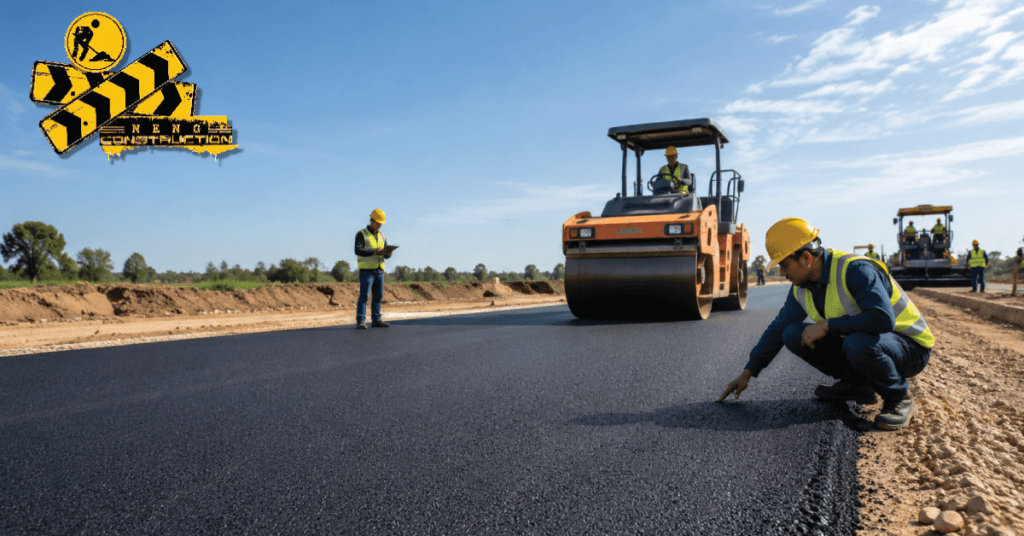
When people talk about “asphalt roads,” many may think of the smooth black road surfaces commonly seen in villages, factories, parking areas, or project roads. However, in actual construction work, this type of material has more details than what appears on the road surface.
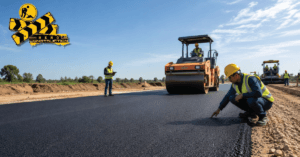
The asphalt road surface commonly used today is known as Asphaltic Concrete. It is a pavement material made by mixing aggregates, sand, stone dust, and asphalt cement through a temperature-controlled process. The mixture is then laid and compacted until it becomes a dense road surface capable of supporting traffic and regular use.
This article will introduce Asphaltic Concrete in a simple and easy-to-understand way. It is suitable for landowners, project managers, or anyone planning to build roads, parking areas, or access ways for different types of properties.
What Is Asphaltic Concrete?
Asphaltic Concrete is a type of road surface material whose main components are :
| Component | Function |
|---|---|
| Aggregates / Crushed Stone | Forms the main structure of the pavement and helps support loads. |
| Sand | Helps fill the gaps between aggregates. |
| Stone Dust | Helps make the mixture denser and improves bonding. |
| Asphalt Cement | Acts as a binder that holds all materials together. |
Although the word “concrete” is included in its name, Asphaltic Concrete is not the same as cement concrete used for house floors or general concrete roads. The key difference lies in the binding material.
- Concrete roads use cement as the binder.
- Asphaltic roads use asphalt cement as the binder.
For this reason, asphaltic roads are generally more flexible and, in many cases, provide a smoother driving surface.
Why Are Asphalt Roads a Popular Choice?
Asphaltic roads are widely used because their properties are suitable for many types of pavement work, especially in areas that need to be ready for use quickly and require a smooth road surface.
Smooth Surface and Comfortable Driving : Asphaltic Concrete provides a relatively smooth road surface, helping reduce impact while driving. It is suitable for areas with regular vehicle access, such as village roads, factory roads, warehouse entrances, and parking areas.
Faster Construction Time : Compared with concrete roads, asphaltic roads usually take less time to construct and can often be opened for use more quickly because they do not require several days of concrete curing. This makes them suitable for areas where long road closures should be avoided.
Easy Spot Repairs : If the road surface develops potholes, cracks, or surface deterioration, asphaltic roads can often be repaired in specific areas more easily than removing and replacing large concrete slabs.
Suitable for Various Types of Areas : Asphaltic Concrete can be used for new road construction, overlaying existing surfaces, parking areas, access roads, and improving old road surfaces to make them more usable again.
An Asphalt Road’s Strength Does Not Come from the Surface Layer Alone
One common misunderstanding is the idea that “the thicker the asphalt layer, the more durable the road will be.” In reality, the strength of a road does not come from the asphalt surface layer alone. It also depends heavily on the base layers underneath.
A road is a bit like a construction sandwich. The top layer may look smooth and beautiful, but if the lower layers are weak, unstable, or not properly compacted, the asphalt surface above can eventually crack, sink, form depressions, or become uneven.
In general, road construction involves several layers, such as:
| Road Layer | Importance |
|---|---|
| Existing Soil / Subgrade | The lowest foundation layer, which must be sufficiently compacted. |
| Subbase Layer | Helps distribute loads and adjust the road level. |
| Base Layer | The main load-bearing layer before the road surface. |
| Asphaltic Layer | The top surface layer used for driving and daily traffic. |
If the existing soil or base layer is weak or unstable, the road may still deteriorate quickly, even with a newly paved asphaltic surface.
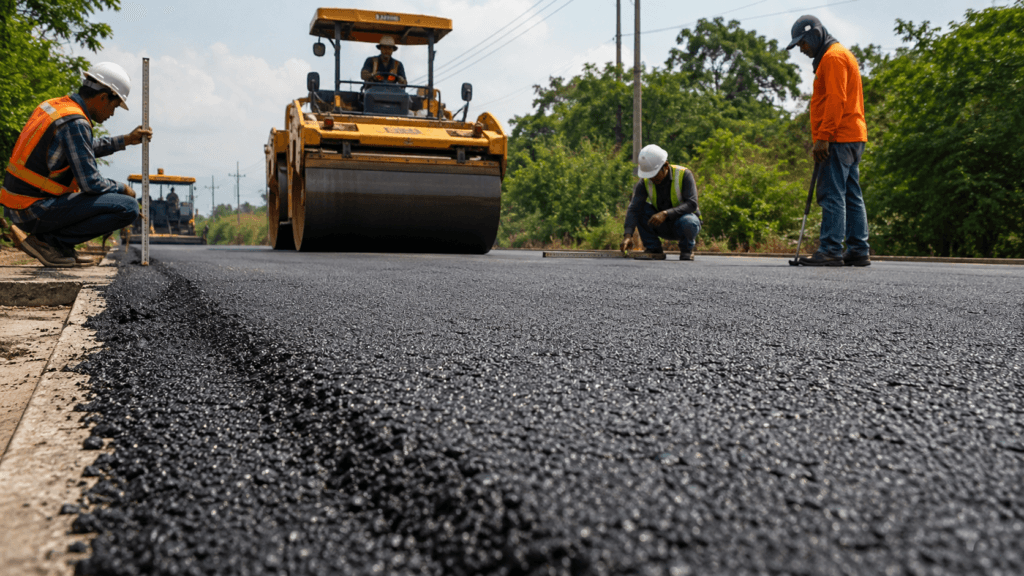
Common Factors That Cause Asphalt Roads to Deteriorate Quickly
Asphalt roads do not always deteriorate because of poor-quality materials. In many cases, damage happens because of a combination of site conditions and actual usage.
Poorly Compacted Existing Ground : If the lower ground is still soft, has voids, or has not been compacted properly, repeated vehicle movement can cause the road surface to sink. This may lead to depressions, uneven areas, or wheel ruts.
Standing Water or Poor Drainage : Water is a silent enemy of asphalt roads. If water seeps down into the base layer, it can weaken the lower structure and cause the road surface to deteriorate more quickly.
Thickness Not Suitable for Usage : A road used mainly by small vehicles and a road with frequent truck traffic should not have the same structure. If the asphalt thickness or base layer is not designed for the expected vehicle load, the road may develop wheel ruts or cracks sooner than expected.
Improper Temperature During Paving : Asphaltic Concrete is a temperature-sensitive material. If transportation takes too long, paving is delayed, or compaction is done when the material has become too cool, the surface density may not be as strong as it should be.
Usage Heavier Than the Original Design : Some areas are initially designed for light vehicles, but later become frequently used by ten-wheel trucks, trailers, or heavy transport vehicles. In this case, the original road structure may not be able to support the increased load.
What Types of Work Is Asphaltic Concrete Suitable For?
Asphaltic Concrete is suitable for areas that require a smooth road surface, convenient use, and fast opening for operation, such as:
| Type of Work | Why It Is Suitable |
|---|---|
| Village Roads | Provides a smooth driving surface and a clean, organized appearance. |
| Factory Roads | Supports internal traffic within the area. |
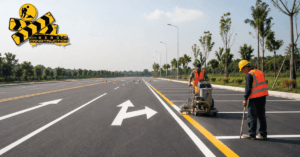
| Parking Areas | Provides a smooth surface where traffic lines can be clearly marked. |
| Project Entrances and Exits | Helps make the area look more organized and accessible. |
| House or Building Entrances | Easy to use and quick to construct. |
| Overlay Work on Existing Surfaces | Helps restore old road surfaces and make them smoother again. |
However, if the area is used by very heavy trucks, has soft soil conditions, frequent standing water, or is under heavy use at all times, the base layers may need to be specially designed to suit the actual conditions. The asphaltic surface layer alone should not be the only factor considered.
Asphaltic Concrete vs. Concrete Roads: What’s the Difference?
Many people are unsure whether they should choose an asphalt road or a concrete road. In reality, there is no single best answer, because the right choice depends on the budget, site conditions, and type of usage.
| Topic | Asphaltic Concrete | Concrete |
|---|---|---|
| Road Surface | Smooth and generally more comfortable to drive on. | Hard and solid. |
| Construction Time | Usually faster to construct. | Requires time for concrete curing. |
| Repairs | Easier to repair in specific areas. | May require cutting and removing sections of the slab. |
| Flexibility | More flexible. | More rigid. |
| Appearance | Black, smooth, and clean-looking. | Gray and strong-looking. |
| Usage | Suitable for general roads, parking areas, and project roads. | Suitable for areas with heavy loads or certain types of heavy-duty use. |
If speed, a smooth surface, and easy repairs are important, Asphaltic Concrete is an interesting option to consider. However, if the area needs to support very heavy loads or is used for heavy industrial purposes, the road structure should be considered in greater detail.
What to Know Before Building an Asphalt Road
Before starting road construction or asphalt paving, landowners should prepare some basic information. This helps make the work assessment more accurate.
1. How many square meters is the area?
The size of the area affects the amount of materials, machinery, working time, and budget required.
2. What types of vehicles will use the road?
Sedans, pickup trucks, small trucks, and heavy trucks require different road structures. Vehicle weight is one of the key factors in road construction.
3. What is the existing surface?
The existing surface may be soil, gravel, crushed stone, old concrete, or existing asphalt. Each surface type requires a different preparation method.
4. Is there standing water?
If there is standing water, the ground level and drainage should be corrected first. Paving over the area without solving the root cause may lead to repeated road damage.
5. How soon does the area need to be used?
Asphaltic Concrete is suitable for projects that need to be opened for use quickly. However, the compaction process and finishing quality still need to be properly controlled.
How Thick Should Asphaltic Concrete Be?
There is no single asphalt thickness that works for every area, because it depends on the condition of the existing ground and the expected traffic load.
In general, areas used mainly by light vehicles may require less thickness than areas where trucks regularly enter and exit. For heavy-use areas, both the base layers and the asphalt surface thickness should be carefully designed to suit the actual usage.
The important point is that the decision should not be based only on the price per square meter. A very low-cost job may reduce certain details, such as asphalt thickness, compaction quality, or ground preparation. These are parts that may not be visible when the work is first completed, but the effects can start to appear after the road has been used for some time.
How to Check Whether an Asphalt Road Is Well Built
After the work is completed, landowners can make an initial observation by checking several key points:
- The road surface is smooth, with no obvious waves or uneven areas.
- There is no standing water after rainfall.
- The edges of the pavement do not break or peel off easily.
- The ground level slopes properly toward the drainage area.
- The road surface is well compacted and does not crumble.
- The joint between the existing surface and the new surface is neat.
- Vehicles can drive over the road smoothly without unusual bumps or impact.
A good asphalt road is not judged only by how “glossy black” it looks. What matters more is proper leveling, a firm base, and effective drainage.
Conclusion
Asphaltic Concrete, or asphalt road surface, is suitable for many types of work because it can be constructed quickly, provides a smooth driving surface, offers comfortable use, and is relatively easy to repair. However, the quality of an asphalt road does not depend only on the black surface layer on top.
The key factors include proper site assessment, ground preparation, drainage, choosing the right thickness for actual usage, and correct compaction methods.
To put it simply:
A good asphalt road does not start when the asphalt is laid. It starts with proper ground preparation.
The road surface is what we see, but the base layers underneath are what carry every wheel, every load, and every day the road has to do its job.